Bolo Sans Rival. Call it by any name (Bolo, Gateau or Cake) you like, this is a dessert that is supposedly without a rival – Sans Rival! Catherine of Munchie Musings was our November Daring Bakers’ host. She challenged us to make a traditional Filipino dessert – the delicious Sans Rival cake! There was also an option of an additional Filipino dessert called Bibingka which comes from her friend Jun of Jun-blog.
I was pleasantly surprised when I saw this month’s Daring Bakers challenge (the group no longer exists). Though the Gateau Sans Rival is of French origin, and it is a much loved cake not only in the Philippines but also here where I live in Goa. Here, the Bolo Sans Rival as it is known (Bolo is Portuguese for “cake”), is a traditional Christmas time favourite though I understand not too many people make it at home these days.

What’s a French cake doing in India, or Goa to be precise?
Goa used to be a Portuguese colony and they were here for for over 400 years. Naturally, they influenced the Goan Catholic cuisine to a very large extent. The Portuguese brought with them their food/ ingredients on their voyages to Goa. When these were used up, they looked for locally available substitutes. So if the recipes required almonds or walnuts, these were replaced by cashewnuts which were available in plenty. Similarly, the French Gateau Sans Rival (an almond daquoise) became the Bolo Sans Rival (a cashewnut daquoise) in Goa.
The Goan Bolo Sans Rival recipe calls for almond extract, probably a nostalgic retention of the almonds from the original recipes. In Goa, the Bols Sans Rival has layers sandwiched with a simple buttercream, and not the French buttercream of the original. It is especially interesting to note that both places, the Philippines and Goa, are rather warm and highly humid which is not exactly good news for meringue or buttercream. Yet this cake continues to be a festive tradition here. Here is a detailed video explaining how to make a Sans Rival cake.

I decided to make only the Bols Sans Rival and not the Bibingka. Interestingly, Goa is famous for a dessert called Bebinca is also famous for a dessert called Bebinca. This is however less like the Philippine Bibingka and more like the Indonesian Kek Lapis.
I made a small Bolo Sans Rival with Indian flavours. So I added cardamom and saffron to the buttercream. I made some very small changes to the given recipe. I halved the original recipe and added only a touch of cocoa to provide some colour contrast to my yellow buttercream.

Once I halved the recipe, I realised I didn’t have the right sized pans to bake my meringue in. So what I did was to spread out the cashewnut meringue as four 6” circles on parchment paper and bake them. I later realised I could have piped out the meringue into circles instead of spreading it out, for neater circles!
I also halved the buttercream recipe but found it wasn’t quite enough even though this cake requires very thin layers of it, so I had to make some more. So if you make a half recipe, you might just need a little more than the recipe of buttercream. Please note that both these recipes are for a 6” cake (half the original recipe).
Verdict:
An interesting cake and was a hit with everyone who had a slice. The crunch of the crisp and nutty meringue with the soft, creamy buttercream was nice. My daughter’s response was “What’s not to like about meringue and buttercream?”, and that’s from someone who loves both! For me, it was a chance to try my hand a local traditional favourite and I’m glad I did. Did I feel it was “Sans Rival”? I don’t think so though it was pretty good, though many of my fellow bakers might not agree with me.
I found the cake easy to make since I’m comfortable with making both meringue and French buttercream. This cake also has the advantage of being a “make ahead” cake and so is a great dessert to serve to company. Though the recipe says this serves six people, we found it so rich that it served 10!

Bol Sans Rival
Ingredients
For the Layers :
- 5 egg whites room temp
- 1/2 cup granulated sugar
- 1/2 tsp cream of tartar
- 1 tbsp cocoa optional and not traditional
- 1 cup finely chopped and toasted cashewnuts
For the Buttercream:
- 3 egg yolks room temperature
- 1/2 cup granulated sugar
- 1/8 cup water
- 1/4 tsp to 1/2saffron threads
- 4 pods cardamom powdered
- 140 gm unsalted butter room temperature
Instructions
For the Layers :
- Note: You will need to make four layers, each 6” in diameter. You might need to bake in 2 batches. Be sure to use fresh parchment paper and cooled pans/ trays for each batch. If you have 6” pans use them. I didn’t so I used cookie sheets.
- Cut out parchment circles (or squares) large enough to comfortably accommodate 6” meringue circles and which will sit properly on your baking sheets. On the underside, draw the outline of a 6” circle to guide when you are piping the meringue circles. Grease/ butter the side of the parchment pieces that you will pipe the meringue on. Keep them aside.
- In a large clean, dry glass or metal mixing bowl, beat egg whites on medium until foamy (about 2 minutes). Sprinkle with cream of tartar. Gradually add the sugar, a couple of tablespoons at a time, continuing to beat now at high speed until stiff shiny peaks form. (about 7-10 minutes)
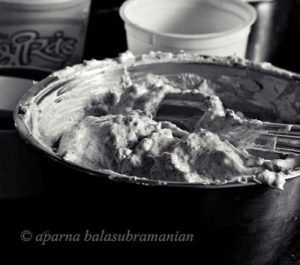
- Fold in finely chopped nuts, without deflating the meringue. Divide the meringue into four equal parts. Use a bit of meringue to stick the parchment pieces to the baking sheets. Spread/ pipe each meringue portion on each sheet into a 6” circle. in pans, evenly to edges. If doing batches, use fresh parchment paper and cooled pans for each batch.
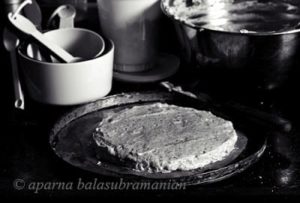
- Bake 160C (325F) for about 30 minutes, or until golden brown. Remove the meringue from the baking pans while still hot; allow to cool slightly. Peel off the parchment paper while it is still warm, it is difficult to remove sometimes when they have completely cooled.
- My meringue circles were still a bit soft so I left them in the warm oven after I had switched it off, to crisp them. When cool, trim edges so that all 4 meringue layers are uniformly shaped. You have to be careful here, as the meringue can crack/ break sometimes. Keep aside or store in an airtight container, separating the layers with parchment paper till you are ready to assemble the cake.
For the Buttercream :
- In a largish bowl, beat the egg yolks at high speed until they double in volume and are a lemon yellow colour.
- Put the sugar, water and saffron threads in a heavy pan and cook over medium heat, stirring the sides down only until all the sugar is dissolved and the syrup reaches one-thread stage (112C/235F).
- With the mixer on high, very slowly pour the syrup down the sides of the bowl with the yolks in it, until all has been added. Be careful as the very hot syrup could burn you if it splashes from the beaters.
- Continue beating on high until the mixture is ROOM TEMPERATURE (about 15 minutes). Still on high speed, beat in the soft butter a tablespoon at a time. Add the powdered cardamom and beat till mixed. Refrigerate the buttercream for at least an hour, and whip it smooth just before you use it.
Assembling the Bolo Sans Rival:
- Set one meringue circle on cake board/ plate with a dab of butter cream to hold it in place. Spread a thin layer of buttercream and then place another meringue circle on top. Repeat with the other two layers and buttercream and finish by covering the top and sides with a thin layer of buttercream.
- Decorate the sides of the cake with the coarsely chopped cashew nuts and refrigerate till serving time. The cake is easier to cut when it is cold. This cake keeps well in the freezer. If you freeze it, remember to move it to the refrigerator an hour before serving.
 I'm Aparna and My Diverse Kitchen is my ovo-lacto vegetarian food blog where you'll find recipes, food stories & photography. I've been blogging since 2007 and believe the kitchen, and the dining table (by extension) is really the heart of a home.
That looks perfect for a X’mas dessert. Lovely color combo and I’m drooling already
It is an excellent dessert, and I don’t even like buttercream! 😀