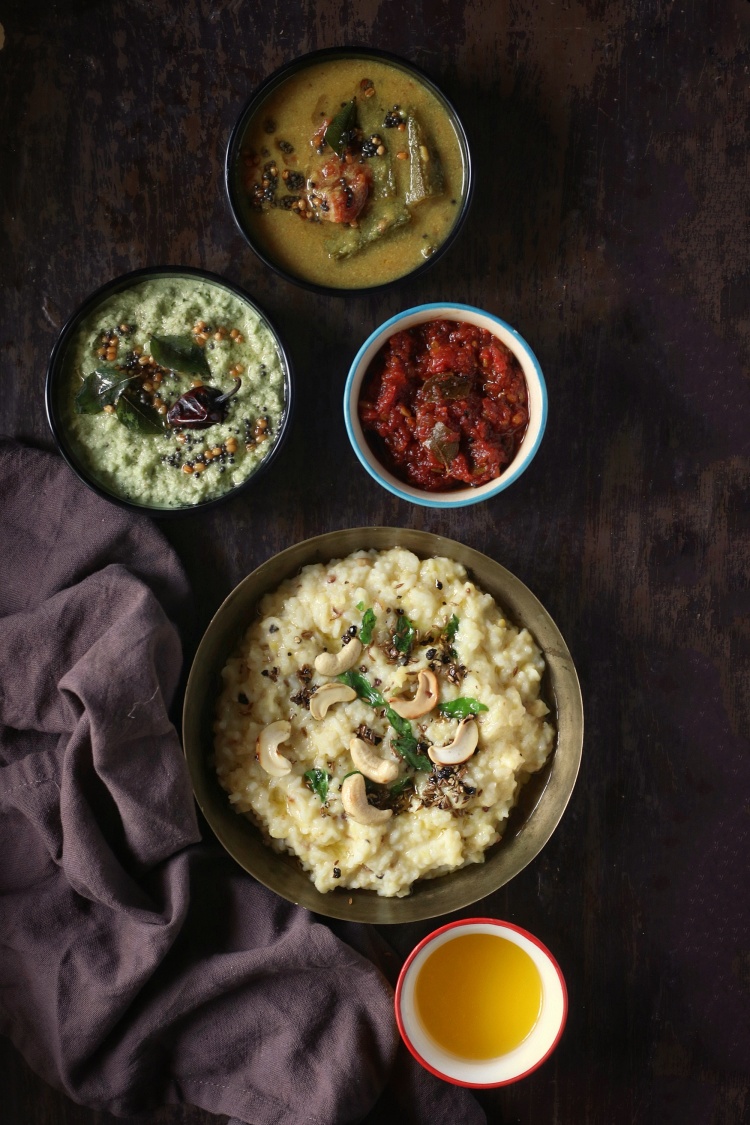
You might have noticed that Venn Pongal, Coconut Chutney and Tomato Gojju are not one recipe but three. That’s because Venn Pongal is not complete unless served with Sambhar or Coconut Chutney and Tomato Gojju. Today, the 14th of January, is a very auspicious day that is much celebrated across India. It goes by different names depending on where it is celebrated, like Lohri, Bihu, Makara Sankranthi, Thai Pongal etc.
Astronomy and astrology are an intrinsic part of traditional Hindu life. Important astronomical events are woven into Hindu celebrations and festivities. This day, Makara Sankranthi, marks the beginning of the Sun’s transit northwards to the Tropic of Capricorn (Makara) or from the “Dakshinayana” to the “Uttarayana”. This day marks the end of winter and beginning of warmer days in the North. It is also a celebration of the winter harvest and a Thanksgiving of sorts.
It is also the first day of the Tamil month of “Thai”, hence the name Thai Pongal. “Pongal” in Tamil means to “boil/ spill over”. In Tamilnadu, this day typically starts with heating milk in a auspiciously decorated clay pot until it boils and spills over. This symbolizes a hope that the coming year would “overflow” with peace and prosperity.
Pongal is actually celebrated over 4 days in Tamilnadu. The first day is celebrated as “Bhogi”. A ritualistic spring cleaning is done and all old and useless things in the house are cleaned out and piled outside. Homes are painted and decorated. Even domestic cattle (usually cows) have their horns painted in beautiful patterns. Early in the morning on “Bhogi”, everyone gathers around and the mound is lit into a bonfire.
The second day, today, is “Thai Pongal”. Milk is ritually boiled and spilt, and sweet and savoury rice and split moong lentil dishes are cooked with milk. The sweet version is Chakkarai/ Sakkarai Pongal (cooked with jaggery) and the savoury one is called Venn Pongal.
The third day is celebrated as “Maatu Pongal”. “Mattu” refers to cattle which are a very important part of an agricultural society. They provide milk and organic fertilizer and dung which is dried and burnt in fires. They are the wealth of the farmer. Bulls and cows are bathed, and their horns decorated in bright colours and with flowers. Then they’re ritually honoured and fed., and ritually honoured. In the countryside, this is day for traditional cattle races called “Jallikattu”.
The fourth day and last day is “Kaanum Pongal”. This is a day for family get-togethers and visits with family and friends. “Kaanum” means seeing and traditionally farming families (especially landlords) would thank all who helped and supported them through the harvest, with gifts of clothes, money and food.
As Palakkad Iyers, we celebrate Pongal somewhat differently from the way it is celebrated in Tamilnadu. We celebrate only the Makara Sankranthi day and the following day called Mattu Pongal or Kanu. Both are rather simple affairs. Makara Sankranti is also a time to remember departed ancestors. All male members in our community who have lost one or both parents perform the “Tharpanam” which is a ritual remembrance of ancestors.
We boil milk in a specially and ritaully decorated pot in which rice is also cooked to make Pongal. This is offered to the Gods and then shared with the family at breakfast. Those who used to have cows or cattle at home would celebrate Mattu Pongal. The cows would be fed Pongal and bananas. Then we celebrate Kanu by ritually feeding the crows. Rice from the previous day and yogurt, coconut, jaggery and banana, with some turmeric and betel nuts, all placed on pieces of banana leaves in the backyard. This is done early in the morning, only by the women and girl children of the house. They pray that their families stay together in good tmes and tough and then invite the crows to eat.
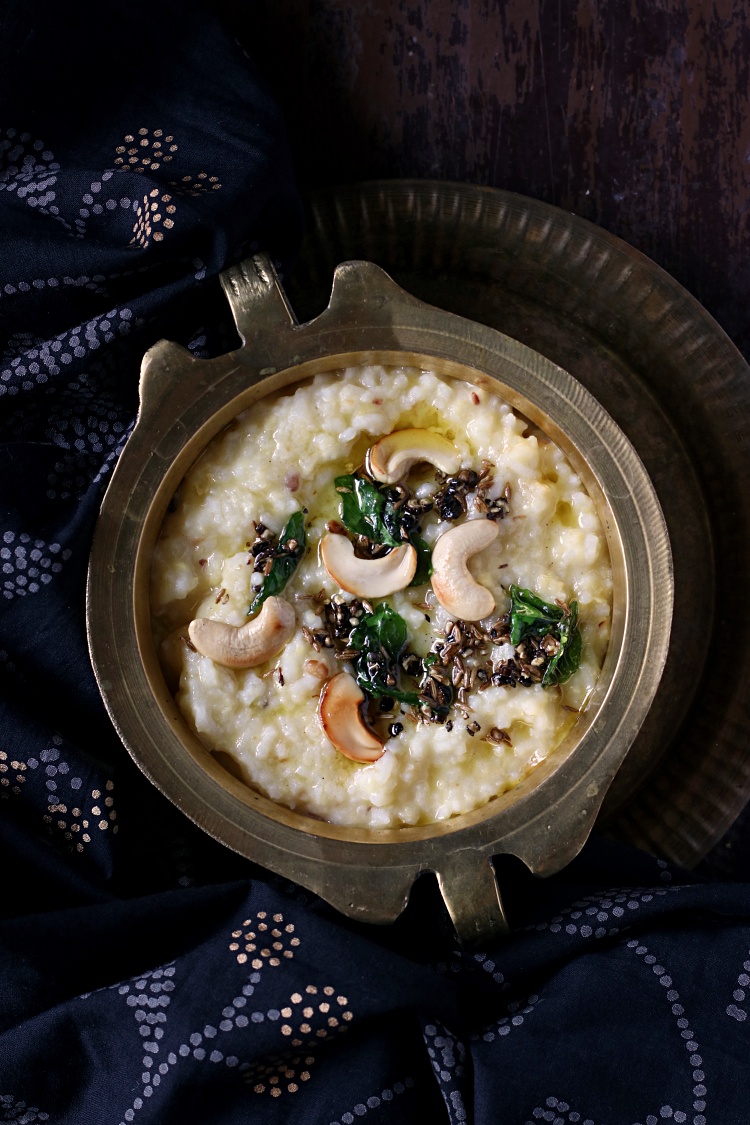
Venn Pongal is very popular in Tamilnadu even on non-festive days. It is often served as breakfast. It is not a spicy rice preparation and pairs well with any lentil based gravy dish that’s a bit spicy and tangy. Traditionally, it is usually served warm with coconut chutney and Sambhar or a similar gravy dish that is tangy. Here however, I’m serving mine here with a non-traditional Gojju or Gotsu. You can find the recipe for Chakkarai/Sakkarai Pongal (Rice and Lentils Cooked in Jaggery and Ghee) here.
There are a couple of things to keep in mind while cooking Pongal, whether sweet or savoury.
- Use a short or medium grained raw rice (not boiled or parboiled) to make Pongal. Use a heritage white rice or Sona Masuri variety of rice. Do not use Basmati or any long grained or aromatic rice to make it. There is a misconception amongst people unfamiliar with Indian cuisine that Indian rice dishes are always makde with Basmati rice. Basmati rice not traditionally used in South Indian cooking.
- Pongal, when cooked, resembles Italian risotto in texture. It should be wet, and not dry. If your cooked rice and lentil looks dry, you can cook it with a little milk and water to loosen it up.
- These are celebratory dishes and so use quite a bit of ghee. Skimping on the ghee will not give you an authentic taste or texture.
- You will find a lot of variation in Ven Pongal recipes depending on who is cooking them. All will have rice, split moong lentils, cumin, black peppercorns and ghee.
- The recipe below is one my mother, and her mother before her, cooked. Here, peppercorns are usually left whole but you can coarsely crush them open if you prefer. Crushing peppercorns makes the Pongal spicier. Those who don’t like pepper can pick them out if they’re left whole. It’s a personal preference.
- The ghee in Pongal not only adds flavour but helps keep it moist. The trick is to use just enough of it so the POngal doesn’t become greasy.
- Pongal is best eaten when hot. It will become lumpy and sticky as it cools.
Venn Pongal, Coconut Chutney and Tomato Gojju
Ingredients
For the Venn Pongal :
- 1 cup short grain raw rice
- 1/2 cup split yellow moong lentils moong dal
- 1 tsp ghee
- 3/4 cup milk (or more if required)
- 5 cups water approximately
- to taste Salt
- 4 to 5 tbsps ghee
- 1 1/2 tsps cumin seeds
- 1 1/2 tsps whole black pepper (or coarsely crushed if you prefer)
- 1/4 tsp asafoetida
- 2 sprigs curry leaves
Instructions
- Heat the 1 tsp of ghee in a pan and roast the split moong lentils, over medium heat, stirring constantly until the lentils give off an aroma and start turning golden brown. Do not brown the lentils. Take this off the stove and cook the roasted lentils and rice together with the milk, water and salt either on the stove-top, MW or in a pressure cooker until well cooked and bit mushy. If your rice-lentil mixture seems a little dry add a bit of milk to make it moist.
- Traditionally, freshly harvested rice is cooked for Pongal. New rice requires more water than aged rice. So the amount of water needed to cook your rice will depend on the variety of rice and its age.
- In a small pan, heat the ghee (do let it become smoking hot), and add the cumin seeds. Stir a couple of times and add the asafoetida powder and black peppercorns. Stir once and turn off the heat. Add the curry leaves. Stir once or twice and once they crisp up, add this seasoning to the rice-lentil mixture.
- Mix well, and do not worry if the rice looks mushy; it's meant to be that way. Serve hot with Coconut Chutney and Gojju/ Ghotsu or Sambhar. This recipe serves 3 to 4 when served with other accompaniments.
Notes


 I'm Aparna and My Diverse Kitchen is my ovo-lacto vegetarian food blog where you'll find recipes, food stories & photography. I've been blogging since 2007 and believe the kitchen, and the dining table (by extension) is really the heart of a home.
Leave a Reply