
Every year, World Bread Day is celebrated across the world on the 16th of October which happens to be today. Why is there a World Bread Day?
Apparently somewhere on the late 1990s to the early 2000s, carbohydrates on the whole were getting a bad name in the more developed countries and a lot people there started a low carb-lifestyle. Commercial bread bakers in these countries saw a dramatic decrease in sales. In order to promote bread as part of a healthy diet and better their sales, the International Union of Bakers and Bakers-Confectioners (UIB) created World Bread Day in 2006.
From 2006 todate, Zorra of Kochtopf has been having a virtual gathering of food bloggers from around the world who celebrate World Bread Day by baking a huge variety of bread. I love bread and really don’t need an excuse to bake it. In fact this year, I baked two breads for WBD – this bread and an Empanada Gallega
The first one I baked with a group of Indian bakers, and this one I baked with the Bread BakingBabes(BBBs)! There’s only one thing better than baking your own bread, and that’s when you bake it with friends.
Tanna chose a Russian Rose Bread for us to bake. This is a filled, rolled and braided bread. It also goes by the names of Russian Braid, Caucasian Bread and if you choose to fill it with cinnamon as a Cinnamon Wreath. There are probably other names for it that I’m not aware of, but whatever you call it, this bread is as beautiful to look at as it is to eat!
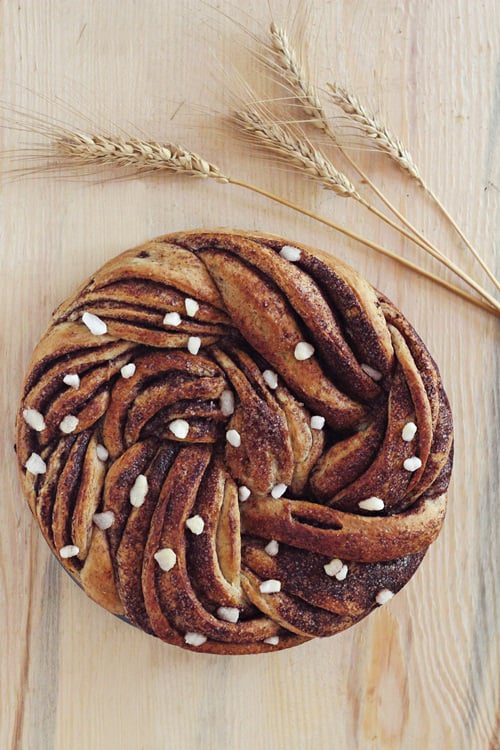
I have no idea about the origins of this bread, or even if it is Russian. It probably is an Eastern European bread given that a lot of braided breads have their origins there. The recipe the BBBs had us bake from suggested using a combination of bread flour, whole wheat flour and sprouted wheat flours. Where I live I’m just happy that I get ordinary flour and that’s what I used. The recipe also suggested a savoury pesto filling but since the bread I baked the previous day was savoury, and I’ve previously made a braided Pesto And Pine NutBread, I decided to make this one sweet and cinnamon-y.

Shaping the bread is perhaps the most complicated part of this bread, and it’s pretty easy at that. All you need to do is roll out the dough, cover it with your filling, roll it up Swiss roll/ jelly roll style, cut it length-wise into two, twist the two strands like a rope and roll that into a circle.
If this sounds a bit confusing just watch this video and then refer to my bread shaping photo-collage above.

It’s really not all that difficult. I’m no bread baking expert and I made it. With very little effort, you end up with a bread that will have people marvel at your bread baking skills. The swirls resemble a flower , so that’s where the name Russian Rose Bread probably comes from, though what it reminded me of was the intricately twisted turbans that Rajasthani men wear.

Russian Rose Bread/ Russian Braid/ Caucasian Bread/Cinnamon Wreath – Baking for World Bread Day With The Babes!
Ingredients
For the dough:
- 4 cups all-purpose flour
- 2 tbsps flax seeds ground
- 2 1/4 tsps yeast dry active
- 2 1/2 tsps sugar
- 1 tsp salt
- 1 tbsp white vinegar
- 1 1/4 cups water warm
For the filling:
- 75 gm butter , soft at room temperature
- 1/2 cup sugar granulated
- 2 tsps cinnamon powdered
- Sugar bits to decorate (optional)
Instructions
- You will need a 10u201d spring form cake tin and a baking sheet for baking this bread. Remove the bottom of the pan, grease the sides well and keep it aside. Also grease the baking sheet. You may use whatever tin you have, but a spring form makes it easier to shape this bread.
- You may knead this bread by hand but I used the food processor. Put all the ingredients, except the vinegar and the water into the processor bowl and pulse a couple of times to mix. Add the vinegar to the water and add this to the processor bowl and knead till you have an elastic dough which is not sticky. If you need to, add a little water or flour to achieve this consistency of dough.
- Shape the dough into a ball and place in an oiled bowl. Turn the dough around till well coated with oil, cover and let the dough rise to almost double (80%). This should take about 45 minutes to an hour.
- Lightly flour your working surface and place the dough on it. Gently flatten it out with your palms and roll out into as large a rectangle and as thin as you can, but not till its translucent. I rolled mine out to about 12u201d by 24u201d.
- Brush the softened butter all over the surface of the rectangle, leaving 1/4" space at the edge. Mix together the sugar and cinnamon powder and sprinkle this uniformly, over the butter. Slowly, tightly and very gently roll the dough into a roulade (pinwheel ), from the longer side. You will now have a very long roulade.
- Take a sharp chef's knife (not a serrated knife) and cut (not saw) the roulade along its length into 2 halves, trying to keep the knife in the middle so you end up with two equal parts (if you can cut down from the seam you will have a neater wreath).
- Try to slowly turn the two halves facing outwards so the layers show up. Place the two halves crossing each other (open roulade layers facing up) to create and X shape. Gently pick up the two ends of the bottom half, and continue to cross them to form a rope. Pinch the ends together, and repeat with the other two ends.
- You now have a two strand rope shape. If for some reason some of the open roulade layers are pointing down or sideways, carefully turn them so they are facing up. Gently pinch the ends to seal.
- If your u201cropeu201d has a thinner end, start with that. Now gently slide your baking sheet under about half your rope of dough. Keeping the thinner end for the centre of your wreath, slowly and very gently, roll the braid sideways (horizontally) into a circle without lifting your hands from the table. You should keep those open roulade layers facing up. Neatly tuck the end of the u201cropeu201d under the wreath.
- Place the spring form over the wreath on the baking sheet. Cover with a kitchen towel and let rise until the braid is three quarters the way up the spring form. This may take from 20 to 40 minutes. Sprinkle some sugar bits on the top, if you choose.
- Bake the wreath at 200C (400F) for 10 minutes and then lower the temperature to 180C (350F). Bake the wreath for another 30 to 40 minutes till brown and done. Cool the bread on a wire rack.
- Slice and serve with coffee, tea or milk. This wreath should serve 6 to 8.
 I'm Aparna and My Diverse Kitchen is my ovo-lacto vegetarian food blog where you'll find recipes, food stories & photography. I've been blogging since 2007 and believe the kitchen, and the dining table (by extension) is really the heart of a home.
Wow what an amazing bread… Bookmarked