
In the southern part of India where I come from, there’s this age old tradition/ custom of never going visiting family or friends empty-handed, even casual visitors would many a times keep with this tradition. This tradition exists in the rest of India and in many other parts of the world too. It is somewhat like taking wine, chocolate, flowers or a small gift for your hosts when you’re invited to dinner.
So we grew up being taught to always carry something (usually a gift of food) for our hosts when we went visiting. I do hesitate to call these “gifts”, because they really were more of an “I wanted to show my affection/ respect so I brought along something you would like” sort of offering.
And if there were elders or children in the home you were visiting, you never went empty-handed because even though there was no compulsion to carry something with you, it was generally considered bad manners or a lack of social courtesies.
One rarely carried expensive gifts and you could never go wrong with taking fruit along with you, and perhaps a few packets of biscuits (what we call our cookies in India) for the children of the house.
I remember as children, we were always more excited to see what the guests to our home brought with them, than the guests themselves except in the rare exception that we were expecting a favourite uncle, aunt or grandparent. And they would invariably bring us what we liked or wanted.
Those were the days when people almost always brought along fruit since most people grew things like bananas, plantains, mangoes, jackfruit, guavas and stuff in their backyards. Apples, pears and other fruit that we take for granted today, were grown in other parts of the country and we saw them only in the pages of our nursery books.
We weren’t much enamoured by fruit and looked forward to the “real” treats like biscuits/ cookies, sweetmeats or small bars of chocolates instead. Remember that these were times when processed and packaged foods were quite expensive and also looked down upon by our elders who couldn’t understand why one would spend a lot more money buying stuff wrapped in plastic/ foil when you could eat much better food made at home!
This tradition is something a lot of us in India still continue with, except these days I tend to take along home-baked goodies when visiting. Recently a friend of ours, whom we hadn’t seen in over a year, was in our neighbourhood and decided to drop by and brought along a huge bag of apples. Now it so happened that just 2 days before this I had been to the market for my weekly haul of vegetables and fruit which also included a kilo of apples!
So here I was, with a whole lot of apples on my hand (in my fruit basket actually!) threatening to go bad on me. So what do you do when life gives you loads of apples, especially when it’s not a favourite fruit in your home? I used my own recipes and suggestions from some friends and turned them into milkshakes, Tarte Tatin, Apple Pie, Apple Chutney, Apple Raita (apple in spiced yogurt), Apple Cake, Apple Fritters, Apple Coffee Cake, Apple Pancakes, hid them in salads and even fed them to our dog! It came to a point where my husband and daughter started saying, “Please don’t say there’s apple in this too!”

And still I had more apples left. That’s when someone on Facebook suggested I try making pasta sauce with apples. I wasn’t sure that this was a good idea but the thought of apples in pasta sauce had me intrigued. A search on the net led me to this recipe and other very positive reactions from various people who had tried it. Since it wasn’t very difficult to make, I thought I would risk it. And I had an idea that if the pasta sauce wasn’t well received at lunch, I could always convert into some sort of soup so no waste either!
I made some small changes to the original recipe and we were very pleasantly surprised at how good the sauce tasted. It is much like the basic tomato sauce for pasta but the apple adds a hint of sweet that balances the tartness of the tomatoes, much like when some people add a bit of sugar to their tomato sauce. Hence it is important to use the slightly tart variety rather than sweet apples or your sauce could end up sweet. The apple also adds body and texture to the tomato sauce, but no one would ever say there was apple in it.

My recipe below is an adaptation of the one in Lidia Bastianich’s book, Lidia Cooks From TheHeart Of Italy. This particular pasta sauce is from Italy’s Trentino–Alto Adige region, where they use apples in a lot of their cooking which isn’t surprising since this region is a leading producer of apples.
Spaghetti Con Salsa di Pomodorie e Mele (Spaghetti With A Tomato-Apple Sauce)
(Adapted from Lidia Cooks From The Heart Of Italy)
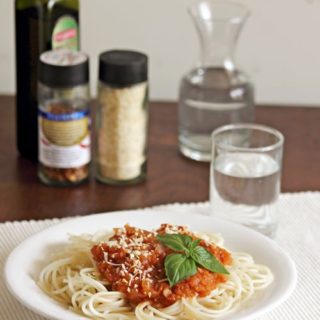
Spaghetti Con Salsa di Pomodorie e Mele (Spaghetti With A Tomato-Apple Sauce)
Ingredients
- 2 cups tomatoes cooked , skinned and de seeded
- 1 green bell pepper (capsicum), chopped
- 2 tbsps olive oil
- 1 onion medium , chopped (about 3/4 cup)
- 1/2 tsp garlic paste
- 1 1/2 tsps red chilli powder
- to taste Salt
- 2 apples firm and somewhat tart
- 250 - 300 gm spaghetti
- as required Parmesan cheese Freshly grated ,
Instructions
- Put the cooked tomatoes and the bell pepper in a blender and purxe9e. Keep this aside. Your tomato purxe9e can be very smooth or a bit chunky. I prefer mine a little bit chunky, because I feel it adds a rustic feel and gives the sauce some character, visually at least.
- If you would like to keep your sauce chunky then purxe9e the tomatoes and the bell pepper separately because chunks of bell pepper doesnu2019t taste good in this sauce! So put about half a cup of the tomato purxe9e and the chopped bell pepper in the blender and purxe9e till smooth. Empty into the rest of the tomato and keep aside.
- Heat the oil in a largish pan, and sautxe9 the onions on medium heat, till they turn soft. Add the garlic paste and cook for another minute. Add your blended tomato-bell pepper mixture and the chilli powder. Season with salt to your taste.
- Bring the whole thing to a boil and then turn down the heat so that sauce continues to bubble and simmer. Stir occasionally and let this cook for about 10 minutes. In the meanwhile, peel and core the apples and then grate them.
- Add the grated apple to the sauce, and allow it to cook for another 15 minutes till the apple is cooked and the sauce thickens to desired consistency.
- While the sauce is cooking, cook the pasta in salted water till al dente. Drain the pasta and put it in the simmering tomato-apple sauce. Toss the pasta till well coated with the sauce. Sprinkle some grated cheese and toss again to mix. Serve hot, with extra cheese on the table if necessary.
 I'm Aparna and My Diverse Kitchen is my ovo-lacto vegetarian food blog where you'll find recipes, food stories & photography. I've been blogging since 2007 and believe the kitchen, and the dining table (by extension) is really the heart of a home.
Beautiful clicks and spaghetti..